MCP Server
AIOZ Storage provides an MCP server that lets MCP-compatible AI assistants work with AIOZ Storage vector buckets, indexes, and vectors. Use it when you want an assistant to create vector resources, insert vectors, retrieve vectors, or run vector search through natural-language prompts.
This page focuses on connecting your MCP client to the AIOZ Storage MCP server and using the available vector tools.
Connect
Add the AIOZ Storage MCP server to an MCP-compatible client using HTTP SSE transport.
Use this SSE URL:
https://mcp-vector.aiozstorage.network/sseAfter the client connects, it should show the AIOZ Storage vector tools.
Authentication
Every MCP tool call requires AIOZ Storage credentials in the tool arguments:
| Argument | Description |
|---|---|
S3_ACCESS_KEY_ID | AIOZ Storage access key ID. |
S3_SECRET_ACCESS_KEY | AIOZ Storage secret access key. |
Example:
{
  "S3_ACCESS_KEY_ID": "your-access-key-id",
  "S3_SECRET_ACCESS_KEY": "your-secret-access-key",
  "vectorBucketName": "your-vector-bucket"
}
AIOZ Storage validates credentials before executing a tool call. Use credentials with only the permissions required for the task.
Important: To create, list, get, or delete vector buckets with the MCP server, first create a Vector Access Grant with All Buckets scope, then generate credentials from that grant. Bucket-level tools require credentials that can operate across vector buckets.
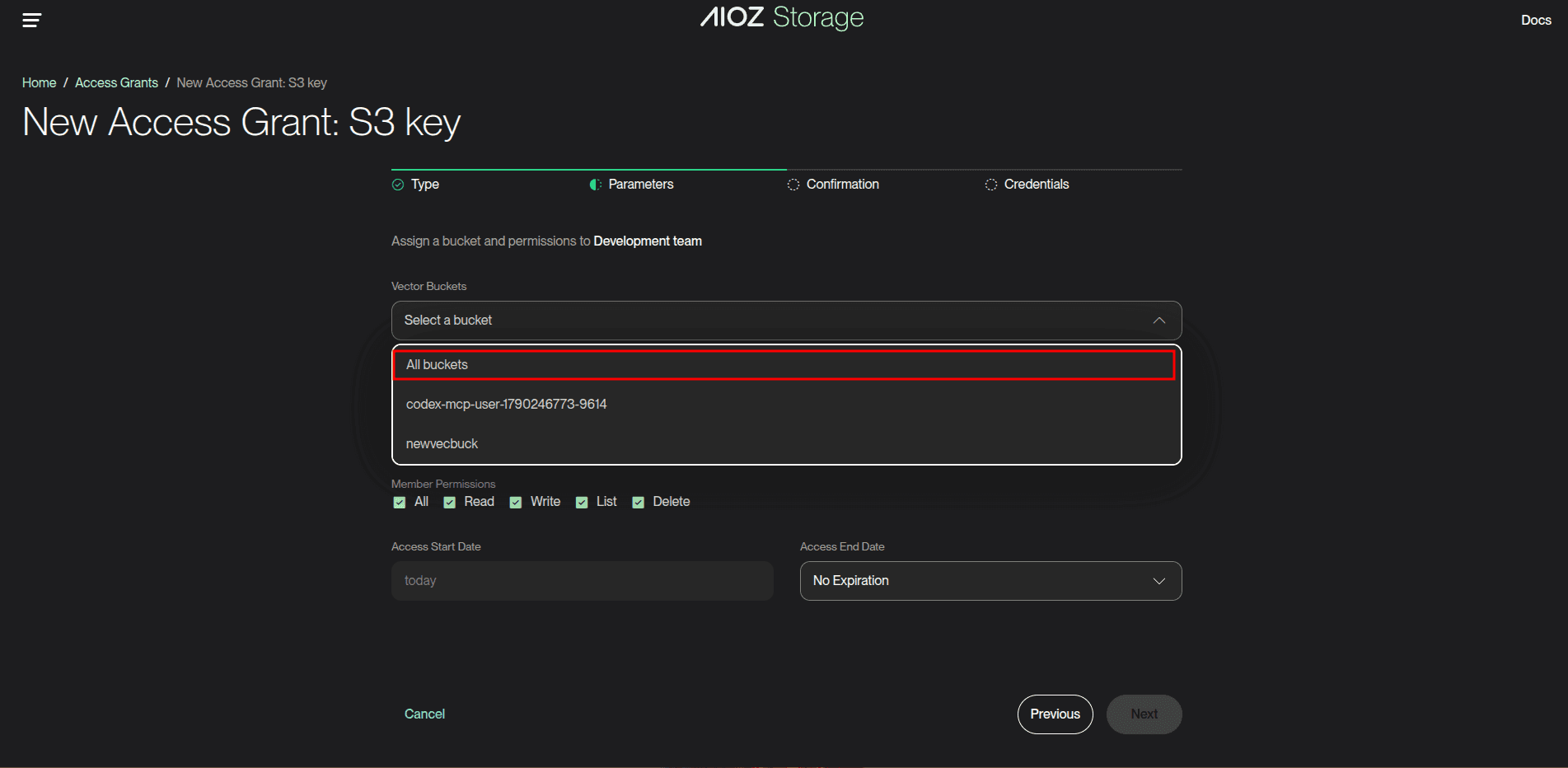
If your MCP client supports saved secrets, store these values in the client and let the client pass them to each tool call. Otherwise, include them when you ask the assistant to perform an operation.
Example prompts
Once connected, you can use natural-language prompts in your MCP client.
Create a vector bucket named your-vector-bucket.Create a cosine vector index named your-vector-index in your-vector-bucket with dimension 1536.Upsert these vectors into your-vector-index and attach title and document_type metadata to each vector.Search your-vector-index for the 5 closest vectors to this query vector. Include metadata in the result.List all vector buckets, then list indexes inside your-vector-bucket.Tools
All tools require S3_ACCESS_KEY_ID and S3_SECRET_ACCESS_KEY.
Vector buckets
Required: credentials generated from a Vector Access Grant with All Buckets scope.
| Tool | Required arguments | Optional arguments |
|---|---|---|
create_vector_bucket | vectorBucketName | tags |
list_vector_buckets | None | prefix, maxResults, nextToken |
get_vector_bucket | vectorBucketName | None |
delete_vector_bucket | vectorBucketName | None |
Vector indexes
| Tool | Required arguments | Optional arguments |
|---|---|---|
create_index | vectorBucketName, indexName, dimension, distanceMetric | None |
list_indexes | vectorBucketName | maxResults, nextToken |
get_index | vectorBucketName, indexName | None |
delete_index | vectorBucketName, indexName | None |
Vectors
| Tool | Required arguments | Optional arguments |
|---|---|---|
put_vectors | vectorBucketName, indexName, vectors | None |
get_vectors | vectorBucketName, indexName, keys | returnData, returnMetadata |
list_vectors | vectorBucketName, indexName | maxResults, nextToken, returnData, returnMetadata |
delete_vectors | vectorBucketName, indexName, keys | None |
query_vectors | vectorBucketName, indexName, queryVector | topK, filter, returnDistance, returnMetadata |
Limits
| Operation | Limit |
|---|---|
create_index.dimension | Maximum 4096. |
list_vector_buckets.maxResults | Maximum 500. |
list_indexes.maxResults | Maximum 500. |
put_vectors.vectors | Maximum 500 vectors per call. |
get_vectors.keys | Maximum 100 keys per call. |
delete_vectors.keys | Maximum 500 keys per call. |
list_vectors.maxResults | Maximum 1000. |
query_vectors.topK | 1 to 100; MCP uses 10 when omitted or set to 0. |
| Vector metadata | Maximum 40 KB and 50 metadata keys per vector. |
| Filterable metadata | Maximum 2 KB per vector. |
Arguments
create_vector_bucket
{
  "S3_ACCESS_KEY_ID": "your-access-key-id",
  "S3_SECRET_ACCESS_KEY": "your-secret-access-key",
  "vectorBucketName": "your-vector-bucket",
  "tags": {
    "environment": "production"
  }
}
create_index
{
  "S3_ACCESS_KEY_ID": "your-access-key-id",
  "S3_SECRET_ACCESS_KEY": "your-secret-access-key",
  "vectorBucketName": "your-vector-bucket",
  "indexName": "your-vector-index",
  "dimension": 1536,
  "distanceMetric": "cosine"
}
Supported distanceMetric values:
| Value | Description |
|---|---|
cosine | Cosine distance. |
euclidean | Euclidean distance. |
dot | Dot product distance. |
The MCP server also accepts l2 as an alias for euclidean and ip as an alias for dot.
The MCP server always creates float32 indexes.
put_vectors
{
  "S3_ACCESS_KEY_ID": "your-access-key-id",
  "S3_SECRET_ACCESS_KEY": "your-secret-access-key",
  "vectorBucketName": "your-vector-bucket",
  "indexName": "your-vector-index",
  "vectors": [
    {
      "key": "vector-1",
      "data": {
        "float32": [0.12, 0.42, 0.87]
      },
      "metadata": {
        "title": "Your document title",
        "document_type": "technical-guide"
      }
    }
  ]
}
Each vector must include:
key: a unique vector key in the index.data.float32: the vector values.metadata: optional JSON metadata.
The vector length must match the index dimension.
Use at most 500 vectors in one put_vectors call.
get_vectors
{
  "S3_ACCESS_KEY_ID": "your-access-key-id",
  "S3_SECRET_ACCESS_KEY": "your-secret-access-key",
  "vectorBucketName": "your-vector-bucket",
  "indexName": "your-vector-index",
  "keys": ["vector-1", "vector-2"],
  "returnData": false,
  "returnMetadata": true
}
list_vectors
{
  "S3_ACCESS_KEY_ID": "your-access-key-id",
  "S3_SECRET_ACCESS_KEY": "your-secret-access-key",
  "vectorBucketName": "your-vector-bucket",
  "indexName": "your-vector-index",
  "maxResults": 100,
  "nextToken": "",
  "returnData": false,
  "returnMetadata": true
}
Use nextToken from the previous response to continue pagination.
Set returnData or returnMetadata to true only when you need vector values or metadata in the response.
query_vectors
{
  "S3_ACCESS_KEY_ID": "your-access-key-id",
  "S3_SECRET_ACCESS_KEY": "your-secret-access-key",
  "vectorBucketName": "your-vector-bucket",
  "indexName": "your-vector-index",
  "queryVector": [0.11, 0.44, 0.86],
  "topK": 5,
  "filter": {
    "document_type": "technical-guide"
  },
  "returnDistance": true,
  "returnMetadata": true
}
topK defaults to 10 when omitted or set to 0.
Set returnDistance: true explicitly when you need distance scores. Set returnMetadata: true explicitly when you need metadata in the result.
Metadata filters can match direct key/value pairs:
{
  "document_type": "technical-guide"
}
They can also use operators such as $eq, $ne, $gt, $gte, $lt, $lte, $in, $nin, $and, $or, and $not:
{
  "$and": [
    { "document_type": "technical-guide" },
    { "views": { "$gte": 1000 } }
  ]
}
Issues
Missing credentials
Add both credential fields to the tool arguments.
Invalid credentials
Check that the access key and secret key are correct and have permission to list vector buckets.
No query matches
Check that vectors were inserted into the expected bucket and index, the query vector has the same dimension as the index, and any metadata filter is not too restrictive.